Select either page to enlarge it in the PDF viewer. Contact Rand to discuss Agent OS.
RaNDTek LLC Agent OS · Our mission
Using AI to Create Stability for Companies and People.
RaNDTek LLC Agent OS is desktop software, available for alpha testing now. It is intended to become RaNDTek LLC’s main product. Our mission is to help companies take on more work by enabling people to acquire new skills, grow beyond narrowly defined roles, and work across roles and domains. That broader capability can also support long-term retention of talent across the board, especially in downturns and disruptive times.
More work for companies. More opportunity for people. Greater stability through broader capabilities.
RaNDTek LLC also offers consulting in optics, photonics, materials science, physics, and artificial intelligence. That experience informs the Agent OS software. Explore the foundation.
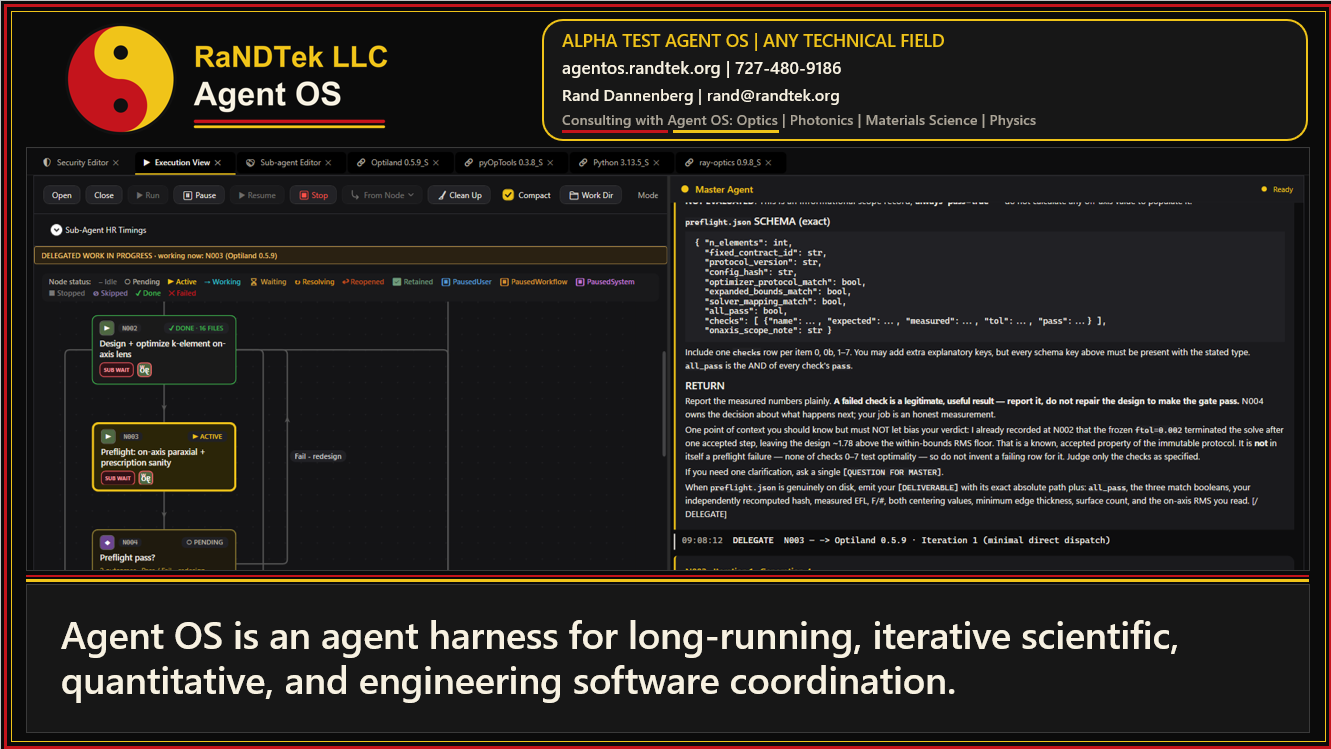
Agent OS is an agent harness for long-running, iterative scientific, quantitative, and engineering software coordination.
RaNDTek LLC Agent OS is software you can alpha test right now, and is intended to become RaNDTek LLC’s main product. Describe the goal in plain English. Agent Teams and structured workflows coordinate AI agents and specialist tools through repeated runs, checks, and refinements, with human review.
RaNDTek LLC also offers consulting in optics, photonics, materials science, physics, and artificial intelligence. That experience informs the software.
Seeking angel and venture backing, advisors, board members, executives, co-founders, and technical staff
Everything. Anything. Together.
RaNDTek LLC Agent OS is desktop software, available for alpha testing now. It is an agent harness for long-running, iterative scientific, quantitative, and engineering software coordination, and is intended to become RaNDTek LLC’s main product.
100 million to 1 billion pre-existing software packages already run the world.They do everything from forensic accounting, engineering, and drug discovery to quantum gravity. AI is not going to re-write them. What will run them all in the Age of Agents?Multi-software work acceleration. Saves time and money.
Two-Second-Takeaway: This is an operating system for large numbers of interoperating agents. Think Windows, Linux, or macOS, but for AI: uniform, rigorously maintained, and built to be used by everyone, everywhere.
Each supported software package is paired with a dedicated agent. Discipline packs organize tools and knowledge around a field, helping people work across software boundaries and build broader capabilities.
Watch the movies to see Agent OS concepts in motion: Agent Teams, discipline packs, security, and 1:1 software-agent workflows. More movies will be added as older use cases are upgraded and rerun in the latest edition of Agent OS.
12discipline genre lanes in the Agent OS structure
240channel slots for tools, codes, dedicated software agents, prompts, literature, workflows, and documentation
1:1one supported software package, one dedicated agent bound to it
Englishplain-language setup by the human operator
Autofully automatic execution, then human review
English in. Automated work out.
The human operates the interface and describes the goal in plain English. Agent OS turns that setup into a team of interacting agents or a structured workflow with multiple subagents. Every supported function and software package is paired 1:1 with a dedicated agent, so the exact tools and code paths needed for the job coordinate as software-agent pairs.
1. Human setupThe operator names the mission, constraints, software, files, discipline, and review requirements in simple English.
2. Agent teamThe human chooses interacting agents, or selects a workflow that creates the needed subagents automatically.
3. 1:1 software agentsEvery supported function and software package is bound to one dedicated agent that knows how to operate it and coordinate with others.
4. Automatic workThe job runs fully automatically until the result is ready for human review, approval, rerun, or release.
What it is
Desktop software for serious agent work. Alpha testing is open now.
RaNDTek LLC Agent OS is software for long-running, iterative scientific, quantitative, and engineering software coordination. It is intended to become RaNDTek LLC’s main product. The human gives plain-English setup instructions and chooses Agent Teams or structured workflows. Each supported function and software package is paired 1:1 with a dedicated agent, and the coordinated task runs through to human review.
Agent teams
Coordinate specialists without losing the thread.
Teams can be selected directly by the human, or generated by structured workflows that create the needed subagents, responsibilities, meeting artifacts, plans, result reports, and human approval gates.
Disciplines
Bind the workspace to a domain.
The human describes the discipline in plain English; Agent OS maps genre and channel organization, supported-code scanning, dedicated function and software agents, starting prompts, best-practices material, local references, populated suites, and expansion suites.
Execution
Move from prompt to workflow artifact.
After the human setup, Agent Teams and structured workflows call the 1:1 dedicated agents attached to functions and software packages: preserving tabbed workspaces, workflow builder state, session-backed panes, snapshots, command surfaces, logs, reports, and result packages.
Understand the product.
Agent OS is a desktop coordination layer that sits above existing software. The human directs the interface in plain English, while Agent Teams and structured workflows coordinate the 1:1 dedicated agents bound to selected functions and software packages.
Operator console: the human states the goal, chooses a discipline, selects allowed software, and sets permission boundaries in simple English.
Team builder: the human chooses interacting agents, including the 1:1 dedicated agents bound to selected functions and software packages, or lets a structured workflow create them as subagents.
Workflow builder: after setup, structured workflows call those bound software-agent pairs and subagents to execute steps, dependencies, artifacts, approvals, and rerun paths automatically.
What the desktop contains.
A serious Agent OS screen is not a chatbot. It is the command surface for intelligent work.
Software channels: every supported function and software package is paired 1:1 with a dedicated agent holding launch rules, file patterns, prompts, command examples, and result readers.
Literature channels: agents search and apply books, papers, manuals, standards, notes, and discipline references during execution.
Human gates: approvals, pauses, denials, security warnings, and final sign-off stay visible in the workflow record.
What customers receive.
Customers can buy a pre-packaged discipline edition with selected genres, code slots, 1:1 software-agent pairs, prompts, literature hooks, and workflows already populated, or buy a completely general version and populate the genres, code slots, agents, references, and workflows themselves.
Pre-packaged discipline: a populated suite for materials analysis, quantum computing, cancer modeling, accounting/business operations, trading/market analysis, media workflow, or another test market, with selected genre lanes and code slots already filled.
General Agent OS: a broad, uncommitted version for customers who want to populate their own disciplines, functions, software packages, 1:1 dedicated agents, literature, and workflows.
Release path: installer, docs, security notes, versioned download, feedback form, and support contact.
Product tour
Flagship product tour: run all software and coding agents on Earth.
The flagship movie presents the core Agent OS thesis: the human operates the interface in plain English, chooses interacting agents or structured subagent workflows, and every supported function and software package acts through its 1:1 dedicated agent inside one fully automated operating model.
Everything. Anything. Together.
The tour lands the central ambition quickly: humans describe work simply; Agent Teams and subagents run the tasks; every software package is paired one-to-one with the dedicated agent that operates it.
The film gives visitors the operating thesis in motion: Agent OS as the desktop layer where setup is human-readable and execution is carried by dedicated agents, automated, traceable, and reviewable.
Modular disciplines, assembled around real software.
Agent OS is designed so each discipline can become its own populated operating workspace: software packages, local files, standards, literature, prompts, workflows, and 1:1 software-agent pairs are assembled into a reusable discipline suite.
Materials analysis is one example. A materials suite can pre-populate analysis codes, simulation tools, plotting and fitting utilities, standards, papers, prior reports, and Agent Teams that know how to move from plain-English objectives to automated analysis packets, reviewable outputs, and reusable workflows.
Other disciplines can follow the same pattern: buy a pre-packaged suite with key lanes already filled, or start from the general Agent OS and populate the discipline, software agents, references, and workflows directly.
Discipline atlas
One operating layer, many expert workspaces.
Agent OS lets a human stand up a discipline-specific desktop by describing the field, tools, files, references, and goals in plain English. The discipline becomes a coordinated set of Agent Teams, subagents, and one-to-one dedicated agents for the local functions and software packages that run the work automatically after setup.
populatedscience
Quantum computing
Useful for circuit construction, noisy simulation, error correction, decoding, benchmarking, and teaching artifacts.
Why it fits: design work already depends on many specialized tools and brittle handoffs.
populatedbusiness
Accounting, tax, and business operations
Populated discipline for document intake, categorization, reconciliation, compliance checklists, planning memos, business reports, and human-reviewed summaries.
Integrated suite: spreadsheets, OCR, local document stores, rule checkers, report generators, accounting exports, and review packets.
Good fit: software-agent pairs can separate intake, classification, reconciliation, exception review, report generation, and final approval.
populatedtrading
Trading cognition and market analysis
Populated discipline for stock research, multi-year chart review, indicator analysis, data summaries, risk notes, decision-support packets, and human-reviewed conclusions.
Integrated suite: market data files, spreadsheets, Python analysis, charting, rule checks, notes, reports, and review artifacts.
Good fit: software-agent pairs can separate data loading, indicator generation, chart interpretation, risk framing, report writing, and final human judgment.
expansionlegal / IP
Patent, claims, and technical legal support
Natural fit for invention disclosure review, prior-art organization, claim mapping, figure checklists, technical declarations, and expert-analysis workflows.
Supports literature-grounded materials screening, cell data analysis, degradation modeling, experiment planning, and report generation.
Integrated suite: Python data stacks, electrochemistry fitting tools, materials databases, simulation and visualization codes.
Anything can be a discipline
Any serious desktop workflow can become a discipline.
The listed disciplines are examples, not the boundary. Agent OS is a general AI workbench: any field with local files, specialist software, reference material, procedures, quality checks, and a human decision-maker can become an Agent OS discipline. The human describes the job; Agent Teams, subagents, and 1:1 dedicated function/software agents run the tools and produce the reviewed result.
any fieldresearch
Any research lab
Experimental planning, literature review, data reduction, analysis scripts, figures, lab notes, and publication manuscripts.
Design, simulation, procurement, fabrication, testing, revision history, media generation, and packaged delivery.
Why this matters
Most agent demos stop before the hard part.
Real work is not only a chat answer. It involves domain tools, local files, libraries, long-running workflows, role separation, repeatability, safety decisions, human judgment, and a persistent desktop place where the human can set direction while agents operate the work.
Local-first control
Designed around a desktop workspace where the human operator sets objectives in plain English, then sees, pauses, reviews, and redirects agent-run work.
Security-aware boundaries
The product direction includes explicit local restrictions, security profiles, approval prompts, and operator-controlled settings.
Discipline-specific operation
The same shell can be specialized for quantum computing, materials analysis, optics, computational cancer research, media workflows, and other expert domains.
One software package, one dedicated agent
The vision is a 1:1 bond: every meaningful function and software tool, from anywhere, has a dedicated agent nailed to it to launch it, understand its files, operate its commands, read its results, and coordinate with other tools.
Teams for cooperative problem solving
Problems can be assigned to as many Agent Teams, subagents, and 1:1 software-agent pairs as needed, with the team dividing work, reporting results, and converging under human review.
Agent-authored workflows
Workflows can be generated and refined from plain-English human setup, then executed with multiple subagents and 1:1 software-agent pairs working in serial, in parallel, or in mixed chains of dependency.
From quantum gravity to accounting
The scope is intentionally broad: any discipline with tools, literature, procedures, and reviewable outputs can become an Agent OS workspace.
Our practical foundation
Consulting that already crosses disciplines.
Rand Dannenberg’s RaNDTek LLC consulting business spans optics, photonics, materials science, physics, and artificial intelligence. That work across disciplines is the practical foundation for Agent OS and its mission to expand what people can do.
Consulting experience grounds the mission in real work. Helping companies take on more work, helping people acquire new skills and grow across roles, and supporting talent retention are outcomes we aim to evaluate as Agent OS reaches users.
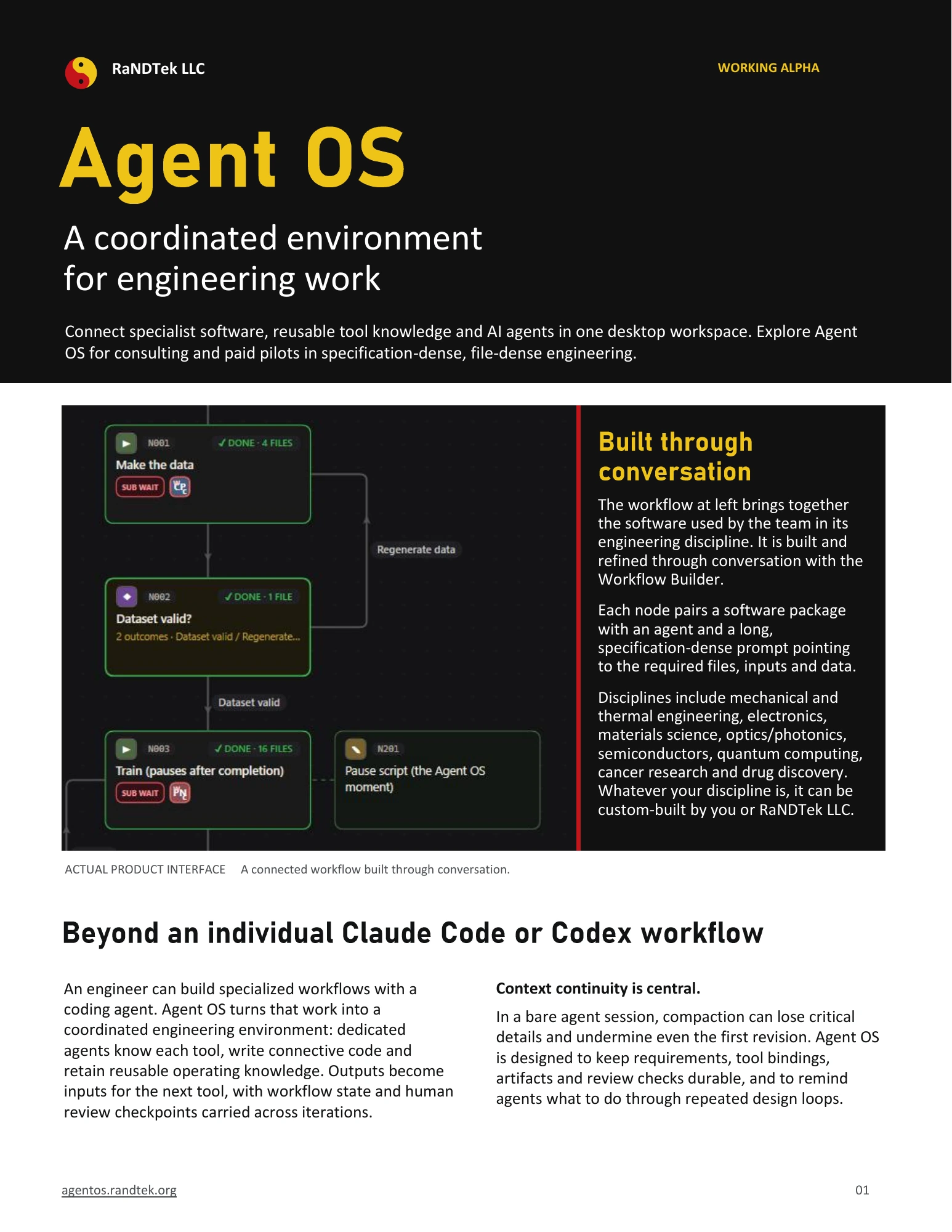
The workflow-discovery movie series shows the product pattern in miniature: source material and a human goal go in, an explicit workflow graph coordinates agents and tools, artifacts are generated automatically, a human review gate decides whether to ship or reroute, and the process improves across iterations.
Workflow evidence: plain-English intent, automated agent execution, review gates, and improved outputs across multiple runs.
Workflow movie evidence
The gallery includes screen-capture automation, security explanations, interacting-agent demonstrations, modular materials analysis, cancer research, quantum computing, computational chemistry, accounting/business operations, and trading/market analysis.
Real intermediate artifacts
Each run carries machine-readable workflow files plus final outputs, transcripts, cleaned subtitles, cut decisions, annotation plans, finalized callouts, audit files, composition scripts, and delivery encodes.
Website video gallery
Actual workflow movies and case cards from the Agent OS evidence base.
These workflow movies and case cards show the operating pattern directly: human setup, automated agent execution, security explanation, Agent Teams, subagents, 1:1 software-agent pairs, and discipline-specific demonstrations across materials analysis, cancer research, quantum computing, computational chemistry, accounting/business operations, and trading/market analysis. More movies will be added as older use cases are upgraded and rerun in the latest edition of Agent OS.
Agents check an AI-designed lens assembly for thread, clearance, mounting, manufacturability, and ray-obstruction issues. This three-session exercise shows where AI checks help, while engineers retain design judgment and acceptance decisions.
Agent OS coordinates AI checks of human-designed CAD against detailed specifications, flagging interference, clearance, and manufacturability concerns for an engineer's review. The example uses an optical assembly; the approach applies across mechanical engineering.
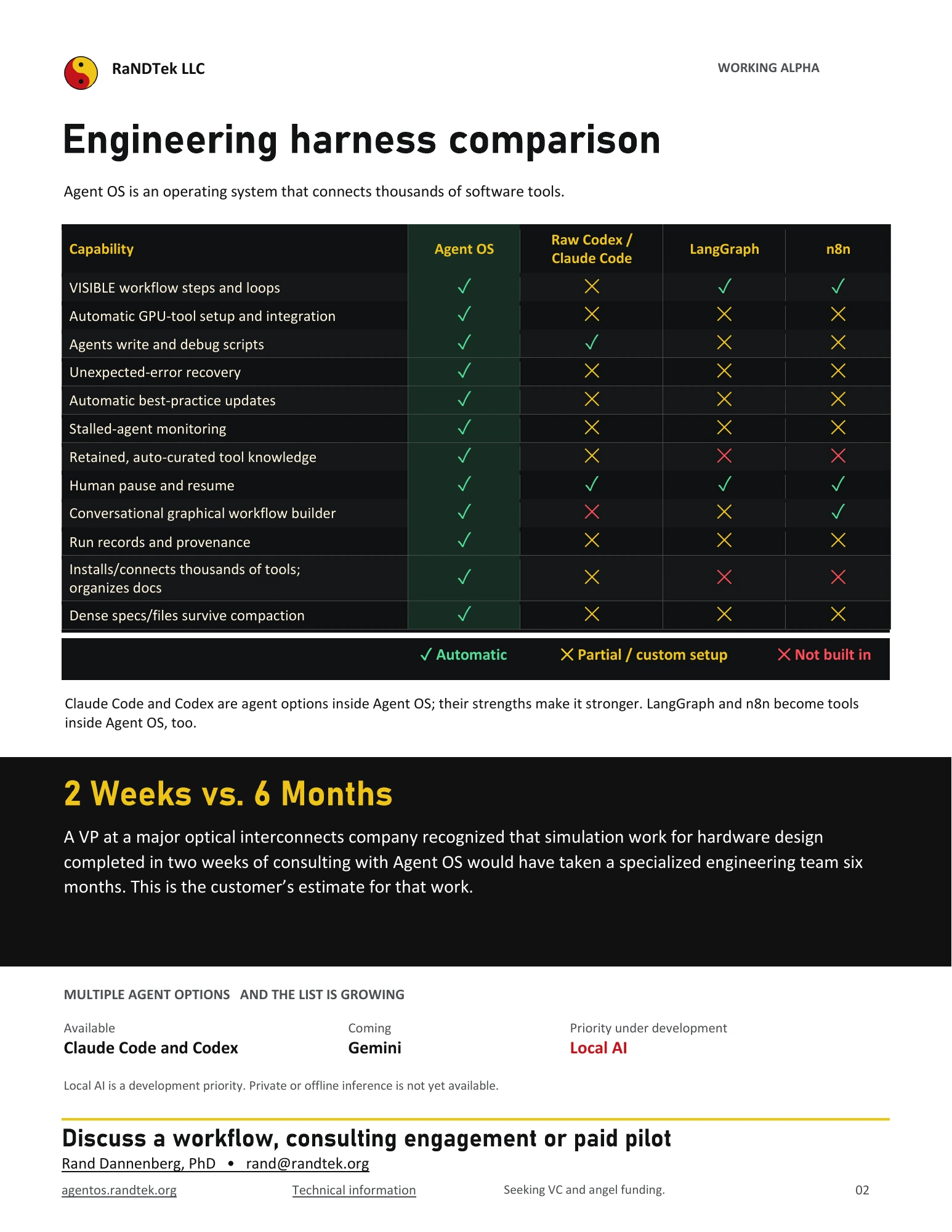
Compare Agent OS with Codex, Claude Code, LangGraph, and n8n across engineering workflow capabilities. Agent and automation tools can operate inside Agent OS as part of a connected software environment.
From a two-page brief to a 14-node heat-flow workflow: GPU simulation, PhysicsNeMo training, Triton serving, and a local Nemotron report, with human approval when checks reveal problems.
An integrated discipline of 79 NVIDIA and supporting tools, including Nemotron, PhysicsNeMo, Triton, LangGraph, and n8n, coordinated by Agent OS on a single-GPU computer.
Multi-agent coordination, team roles, handoffs, review gates, and capability boundaries.
Movie 2 - Modular materials analysis
Discipline-specific tool suites, supported codes, team setup, and materials workflows.
Movie 3 - Cancer research
Multi-scale discipline setup spanning molecular, cellular, tissue, and drug-discovery work.
Movie 4 - Quantum computing
Deeply populated discipline demonstration: SDKs, simulation, error correction, optics, and more.
Movie 5 - Computational Chemistry Discipline
Computational-chemistry discipline case card showing Agent OS coordinating chemistry software, molecular setup, calculation paths, file handling, analysis, and human review.
Computational chemistryDisciplineCase card movie
Movie 6 - Stock Trading Analysis - Nvidia 2 years
Trading-discipline case card showing Agent OS coordinating a two-year Nvidia stock-analysis workflow with market data, charts, indicators, notes, and human review. Analysis workflow evidence only; not investment advice.
Trading analysisNvidiaCase card movie
Movie 7 - What are workflows for?
Workflow-explanation case card showing why Agent OS turns repeated agent work into durable operating structure: reusable workflows, persistent context, software bindings, review points, and artifacts instead of rebuilding the same setup every time.
WorkflowsPersistent contextAgent OS
Movie 8 - Better Movies w/ Annotations and Captions I
Better Movies workflow I: source video to cut, transcript, annotations, captions, and review.
Movie 9 - Better Movies w/ Annotations and Captions II
Better Movies workflow II: automated transcript, annotation, composition, captioning, and review pass.
Movie 10 - Sandboxing and security
Serious educational workflow on isolation, permissions, egress control, and defense-in-depth.
Movie 11 - Sandboxing and security v2
Second pass on the security workflow, showing iterative improvement and review.
Photonic Crystals - Taj Mahal Workflow
LinkedIn case-card movie showing Agent OS applied to photonic-crystal analysis and design exploration, using a visually recognizable Taj Mahal workflow as the demonstration surface.
Accounting Discipline - Business Operations Case Card
Accounting-discipline case card showing Agent OS treating business work as a populated discipline: documents, spreadsheets, categorization, reconciliation, rule checks, reporting, and human review.
Featured LinkedIn case-card movie showing another public development example from the Agent OS evidence base, presented inline with a direct source link for visitors.
Featured LinkedIn case-card movie focused on custom agents and the Agent OS pattern for turning software capabilities into coordinated agent-driven work.
Featured LinkedIn case-card movie documenting another step in the public Agent OS development record, presented as part of the growing case-card gallery.
Featured LinkedIn case-card movie from the Agent OS development record, adding another visible example of the product idea moving from concept into working demonstrations.
LinkedIn case-card movie showing photonic-crystal work: unit-cell geometry, simulation setup, and Agent OS coordination across optics and photonics software.
Optics - Thermal Analysis of Housed Cell Phone Lenses
LinkedIn case-card movie showing thermal analysis of housed cell phone lenses, including autofocus and no-autofocus comparison inside an Agent OS workflow.
Featured LinkedIn case-card movie from the Agent OS progress archive, giving visitors another direct look at the evolving product and development history.
Featured LinkedIn case-card movie from the Agent OS milestone archive, extending the public record of demonstrations, iterations, and product direction.
Featured LinkedIn case-card movie from the earliest public Agent OS archive, helping visitors trace development from near day one to the current system.
The movies and LinkedIn case cards present Agent OS workflows, software coordination, Agent Teams, and reviewable artifacts. They provide a closer look at product development. The mission’s practical foundation is RaNDTek LLC’s consulting work; broader workforce outcomes remain goals to evaluate with users.
Consulting foundation
RaNDTek LLC consulting spans optics, photonics, materials science, physics, and artificial intelligence. That experience informs the mission and the product direction.
Technical demonstrations
The walkthroughs expose the machinery: discipline channels, local files, software suites, security boundaries, logs, workflow artifacts, and repeatable handoffs across packages that used to require brittle manual coordination.
What alpha testing will explore
Evaluate which tasks people can complete, what guidance and review they need, and whether the product helps them contribute across more of their work.
The evidence base already spans optics, photonics, condensed matter physics, materials science, materials analysis, quantum computing, computational chemistry, accounting/business operations, trading/market analysis, and related software workflows.
Team coordination examples
The projects show Agent Teams, subagent contributions, 1:1 software-agent pairs, consolidated plans, result reports, closed meeting summaries, and human completion approval.
Discipline development
The same operating pattern extends to marketing videos, accounting/business operations, trading analysis, and a host of non-technical and technical disciplines already on the plate, not just media production or one scientific niche.
Investor path
Funding turns Agent OS into a product company.
RaNDTek LLC is seeking angel and venture backing to harden, package, document, test, and commercialize Agent OS: a human-operated interface where Agent Teams, structured subagent workflows, and 1:1 software-agent pairs execute technical work automatically after plain-English setup.
The mission is to help companies take on more work as people acquire new skills and grow beyond narrowly defined roles. People who can work across roles and domains can contribute to more of the business. That flexibility can also support long-term retention of talent across the board, especially in downturns and disruptive times. The commercial thesis is that customers who expand their work may adopt additional discipline packs, workflows, users, and support. RaNDTek LLC’s consulting across optics, photonics, materials science, physics, and AI provides the practical starting point.
The current public investor deck is available as a PDF for quick review. Use it with the Investor FAQ, flagship movies, case-card movies, and investor form to follow the full diligence path.
Test markets disciplined pilot programs in selected verticals to discover adoption paths, pricing, onboarding needs, and support burden.
7
Safe inter-computer Agent OS communication develop secure schemes for connecting computers through agents, enabling billions of agents to work cooperatively across machines, software packages, disciplines, and organizations.
Near-term milestones
A
Public proof funnel live production website, FAQ, movie gallery, LinkedIn proof trail, investor inquiry form, alpha request form, and direct contact path working end to end.
B
Customer-driven demo packet v1 three to five short demos showing exact software packages, inputs, outputs, workflow artifacts, review gates, and before-and-after pain relief for real disciplines.
C
Alpha release candidate versioned install package or controlled build, release notes, onboarding checklist, feedback form, issue log, and rollback/uninstall instructions ready for approved testers.
D
Reliability and security pass repeatable tests for Agent Teams, structured workflows, permission boundaries, logs, failure recovery, human review gates, and safe handling of local files.
E
Industry alpha cohort named target SMEs, outreach list, pilot criteria, feedback rubric, first onboarding calls, and selected paid-pilot candidates from technical and non-technical markets.
Angel investors, venture investors, strategic partners, advisors, and potential co-founders can connect directly with RaNDTek LLC to understand the company, the product, the platform direction, and the funding use.
The investor path moves from first contact to a controlled data room after Rand approves the conversation.
Two-minute thesis: expand what people can do, help companies adapt with the people they have, and build a product that can grow as customers enter new areas of work. Read our mission.
Founder call: direct conversation with Rand Dannenberg, CEO/Owner, focused on the product vision, technical history, and commercialization path.
Investor package: public pitch deck PDF, investor FAQ, approved movies, screenshots, workflow artifacts, Agent Team structure, 1:1 software-agent pairs, and selected case-study summaries.
Data room: pitch deck, technical memo, use of funds, hiring needs, release plan, and company background.
Investor inquiry
Request a founder conversation, technical walkthrough, investor demo, or strategic partnership discussion.
Software available for alpha testing now
Alpha test RaNDTek LLC Agent OS in your technical field.
Alpha interest, investor inquiries, and product conversations are routed through RaNDTek LLC. Product binaries are versioned, documented, approved, and distributed only through controlled release channels. Alpha testing centers on the full loop: human plain-English setup, Agent Teams or structured subagent workflows, 1:1 software-agent execution, automated output, and human review.
The software is available for alpha testing now. Use the form below to request access. Rand reviews the request first; approved testers receive the appropriate build, scope, instructions, and feedback path.
Alpha access package.
Approved build: no public binaries until Rand approves the version, notes, and intended audience.
Known scope: each tester receives a clear testing objective: installer flow, plain-English discipline setup, Agent Team workflow execution, 1:1 software-agent pairs, video/demo review, or security boundaries.
Feedback loop: testers report what worked, what failed, what confused them, and what discipline they need next.
Controlled distribution: downloads are gated by request, versioned, logged, and removable.
Turn a field, lab, office, or tool stack into an Agent OS discipline.
Any domain with serious software, documents, manuals, data, procedures, and human review can become a packaged Agent OS workspace. The human describes the intended work; Agent OS coordinates Agent Teams, structured subagent workflows, and 1:1 dedicated agents for the functions and software packages that automate the task path.
What a discipline pack defines.
Plain-English setup: the goal, constraints, inputs, allowed tools, expected outputs, and review requirements set by the human.
Software suite: the programs, scripts, libraries, file formats, command surfaces, and key functions, each paired 1:1 with its own dedicated agent when populated.
Literature base: manuals, papers, standards, textbooks, procedures, prior reports, and local notes that ground the agents.
Interacting agents: researchers, tool operators, validators, security reviewers, writers, and release packagers coordinate as a team.
Workflow templates: common tasks, subagents, inputs, checkpoints, outputs, audit trails, and human approvals.
Success proof: one complete example that shows the discipline producing a reviewed, useful result.
Describe the discipline
Direct contact
Reach Rand Dannenberg and RaNDTek LLC directly.
Use this form for general questions, investor introductions, alpha access questions, partnership ideas, media requests, or anything that does not fit the dedicated investor, alpha, or discipline forms.
No mystery, no routing maze.
Messages route to RaNDTek LLC for review. For urgent or direct contact, use the phone number or email below.
Rand Dannenberg: CEO/Owner, RaNDTek LLC.
Email: rand@randtek.org
Phone: 727-480-9186
Best use: investor contact, alpha access, strategic partnership, discipline pack discussion, or technical demo request.
General contact
Start with intent
What do you want to do?
Everything. Anything. Together.
The goal is operating-system-scale ubiquity for intelligent software interlinking: a desktop layer that can coordinate ALL SOFTWARE ON EARTH through all available coding agents, grounded by all human literature in all disciplines. Every supported function and software package is paired 1:1 with a dedicated agent, so tools, files, models, references, workflows, and human review can work as one connected system.
Not a replacement for Windows, Linux, or macOS; an augmentation layer above them, built to run the intelligent work that spans them.
Agent OS begins from the user's real objective, not from a blank chat box. A person names the work in plain English, chooses or creates a discipline, chooses Agent Teams or a structured workflow with multiple subagents, and Agent OS connects tools, references, 1:1 software-agent pairs, workflow steps, and review gates around that intent. After setup, the task runs fully automatically until the human reviews the result.